
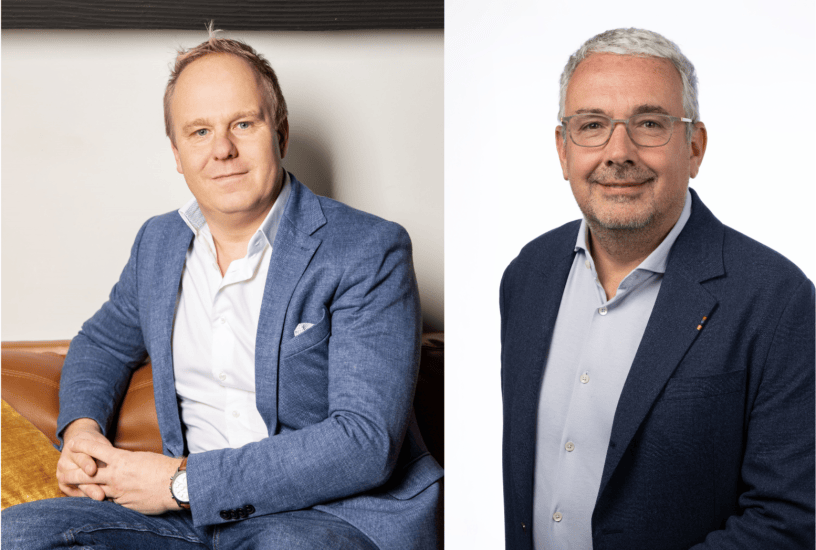
For Shelter IM, growth is not simply about managing more assets or adding more people. Tim Vanvaerenbergh and Benedict Peeters discuss how AI, technology and an open-architecture model are reshaping the way an independent asset manager can grow, while keeping its focus on service, transparency and disciplined risk-taking.
Ecorama Luxembourg: Independent asset managers need to grow to reach critical mass, but growth can threaten the agility that makes them attractive. Have you reached that point yet? And how do you preserve the boutique spirit as you grow?
Tim Vanvaerenbergh, CEO: At our current size, I would say our inertia is still very light. We are still between 15 and 16 people, so we definitely have the boutique spirit. I wouldn’t say we’ve reached that point yet. I can imagine that once an organisation grows to 25 or 30 people, you reach a critical mass where you need to start thinking about these issues. We are currently around €1.5 billion in assets under management, maybe at €2.5 billion we, we mayeventually reach a size where we need to consider how to preserve our entrepreneurial boutique culture. But we are definitely still before that stage.
Benedict Peeters, Founder of Shelter IM: When Tim mentions €2.5 billion or 20 to 25 people, we actually don’t know how many people we will need at that stage. Every day, we see how much time artificial intelligence can save us. The way we use and implement AI has already allowed us not to recruit people we would otherwise have needed. I don’t think people fully appreciate what this could mean. If a group of people is properly trained to use and develop AI, you could potentially make a firm twice as big without twice as many employees. You might even do it with roughly the same number of people. Traditionally, as an asset management firm grows, you expect headcount to grow in sink. I don’t think that will necessarily continue in our industry.
We could see assets under management grow much faster than the number of people needed to manage them. We might eventually be able to manage three times as many assets with only three additional people.
Ecorama Luxembourg: Shelter is backed by Rego Partners, while operating as a regulated asset management company under CSSF supervision. How do you structure that relationship without compromising Shelter’s ability to move quickly?
Benedict Peeters: There are no group requirements because Rego Partners is my company. I own 100% of Rego Partners and am its majority shareholder, so there is no difference in philosophy.
The dual structure mainly exists to create a company that can act as an anchor shareholder of Shelter. If we want to undertake activities that fall outside the scope of a regulated asset management company and do not conflict with our business, we can carry them out through Rego Partners.
Tim Vanvaerenbergh: You could actually think of them as sister companies. If you had a bank, for example, you might have an asset management division and a corporate finance division.
Ecorama Luxembourg: Your model relies on banks, insurers and other distribution partners. At a time when the industry is trying to shorten the value chain and cut costs, how do you make sure each partner adds real value?
Tim Vanvaerenbergh: We are definitely an open-architecture firm. We are open to working with different banks, insurers and distribution partners. That doesn’t mean we work with everyone. We need to be selective.
Sometimes it is a matter of trust; sometimes it is technological efficiency. We may decide not to work with a partner because they are not set up efficiently enough.
Our philosophy is to work with different partners while helping make the overall value chain more efficient.
Ecorama Luxembourg: What criteria do you use when choosing your partners?
Tim Vanvaerenbergh: First, they need to be relevant to the business. Second, they need to be trustworthy and have a good reputation. Third, they need to be efficiently organised, particularly from a technological perspective.
We are not designing rockets. The technology doesn’t have to be cutting-edge, but it needs to be sufficiently automated and ready to connect through APIs, for example.
Benedict Peeters: And, of course, price. We don’t want to work with companies that overcharge. We are looking for high quality at an acceptable price.
The financial industry is not always set up to serve every client in the way they want. We therefore describe ourselves as a service-oriented firm. We are essentially half an IT boutique and half a service centre.
We don’t necessarily want to present ourselves as a company that knows better than everyone else how to manage assets. We know how to service clients efficiently and respond to what they want. That’s different from saying, « I know how to manage assets. Just trust me. »
Instead, we ask: What would you like to do? How would you like us to manage your assets? We then adapt the solution to your needs and deliver it efficiently, using technology.
That is different from a traditional asset management company, where everyone develops their own products and says, « You should buy my product because I do it very well. »
We are different. We ask whether you want exposure to commodities, equities or another asset class, and how much exposure you want. Then we adapt the solution.
Ecorama Luxembourg: So the idea is to adapt the solution to the client, rather than sell a predefined product?
Tim Vanvaerenbergh: We offer both standard and tailor-made solutions. And we don’t limit ourselves to managing assets. We also believe in transparent communication.
Imagine sitting on an aeroplane waiting to depart without knowing when it will leave. Some airlines say nothing. Others have the pilot communicate every five minutes: we expect to leave in 30 minutes, we’re waiting for a slot, there’s a problem here or there.
If you sit on a plane for half an hour and nobody tells you anything, you don’t like the airline anymore, even if the plane itself is perfectly fine. The plane is still the same Boeing 737. But if the airline communicates and is transparent, you appreciate it. That’s how we operate.
Ecorama Luxembourg: So it’s ultimately a matter of trust.
Tim Vanvaerenbergh: It’s trust and transparency. Transparency creates trust.
There has been a lot of opaque behaviour in the financial industry in the past, and clients don’t appreciate that. Many clients have also felt that they were no longer receiving personal service.
Clients want personal service. Not everyone wants to open an app and see everything there. Some people want to understand why their portfolio has changed. They want to hear your view of the market and discuss it. Others want very detailed information, while some prefer something more general. You need to know your clients and understand how to serve them. The model has to be flexible enough to use technology while adapting to each client’s specific needs. That’s the baseline of Shelter: asset management as a service.
Benedict Peeters: One important point is that we don’t work directly with end clients. Our model is based on intermediary distribution partners. These intermediaries provide the personal service to the end client, while we support them as efficiently and automatically as possible.
The intermediary tells us what their end clients need and want: a fund, a mandate, bonds, commodities, equities, or something else. They may tell us that clients in a particular segment require something we could offer. We then try to create a service or a product to meet that need. That’s where we are open to collaboration.
Ecorama Luxembourg: Risk in asset management is also about what you don’t know. So how do you give managers enough freedom to have strong convictions without taking excessive risks?
Benedict Peeters: We basically don’t allow bold intuitions. We don’t necessarily believe in that approach. Our risk culture is about knowing what you don’t know, or at least recognising that you don’t know everything. In portfolio management, we try not to be too bold, too clever or too convinced of our own judgment. Don’t think you are so smart. You are not. That’s why our risk management culture is very much about diversification. You can make bets against your benchmark, but don’t exaggerate. Your risk-taking relative to the market should not be excessive, and we monitor that daily. We don’t want people to act as big risk-takers.
We believe the key in asset management is strategic asset allocation: deciding which geographical areas and asset classes you invest in. It is not about picking individual stocks. If you have a view, let that view be on the macro side rather than the micro side. We don’t need people saying, « This stock is going to outperform that stock. » We need people saying, « I think the US will do better than Europe. » That’s the kind of conviction we have. Macro is more important than micro.
That’s also why we focus on knowing who is good at what. A lot of asset managers and financial institutions want to be good at everything because they want to be a one-stop shop. We don’t think that’s necessarily the right approach.
If you want to invest in emerging-market bonds, for example, there may be a specialist, perhaps an Asian bank or a specialised boutique, with much deeper knowledge of that market. You shouldn’t necessarily ask an asset manager sitting in an office in Europe to do that.
On the other hand, some markets are so efficient that you don’t need an active manager. Take large-cap US equities: all the data is available to everyone, so you can simply buy a passive index tracker at very low cost.
We monitor that constantly. If we found an impressive US large-cap equity manager who consistently beat the market, we would consider moving to them. But we don’t find them, because they don’t exist.
For emerging-market bonds, however, we may know managers who can outperform because they understand those markets better than someone sitting in a Belgian, French or UK office.
Local knowledge is tremendously important in certain markets. You need people with boots on the ground, but not necessarily everywhere. The key is knowing where you need that expertise and selecting the right instruments to implement your strategic asset allocation.
Tim Vanvaerenbergh: I wanted to add something about our risk management culture. It is very much about humility. We think we are smart people, but we don’t think we are so smart that we can take big bets with clients’ money. We do have convictions, mostly at the macro level, and we implement them in portfolios. But if the team is wrong, it won’t destroy the portfolio’s performance.
If we are wrong, we take a small hit, but the portfolio as a whole remains well diversified. That’s very much our culture: be prudent and don’t think you are the smartest person in finance. Nobody is, except maybe Warren Buffett.
Ecorama Luxembourg: And Warren Buffett is unique, of course.
Tim Vanvaerenbergh: He has the track record and the career to prove it. He is a unique person.
There are people who can tell you who the best managers have been, but Buffett built that track record himself. There are still plenty of people, at every age, who think they are the centre of the universe when it comes to understanding financial markets. We don’t think they are. We don’t think we are, either. But we know that we are not. And we don’t have a crystal ball somewhere in the office. We can look around, but you won’t find one. There isn’t one.
En savoir plus sur Ecorama Luxembourg
Abonnez-vous pour recevoir les derniers articles par e-mail.
