
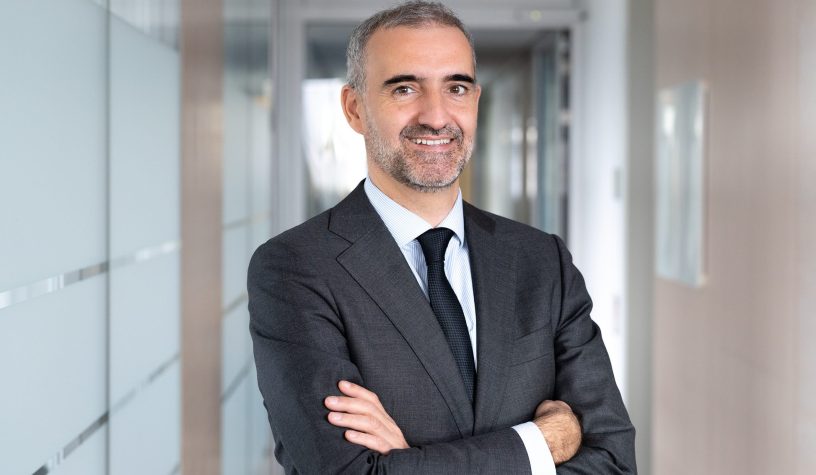
In an interview with Ecorama Luxembourg, Serge Weyland, CEO of ALFI, argues that long-term investment in collective funds is essential to complement and safeguard public pensions. With ‘pay as you go’ pensions poised to become Europe’s major challenge, he sees financial education as the key to turning dormant savings into productive investments.
Ecorama Luxembourg: Luxembourg remains the undisputed leading fund centre in Europe, but global competition is intensifying. If you were a doctor, what would your assessment be today? Are we in peak athletic form, or are we, the underlying symptoms, perhaps the slowdown and new fund launches, require immediate attention? What do you think?
Serge Weyland, CEO ALFI: My assessment as a doctor would be to say that the patient is in good shape, very balanced. We are close to 8 trillion euros of funds domiciled in Luxembourg, of which a little over 5 trillion are UCITS funds or public market funds, and then 3 trillion alternative investment funds. The alternative investment funds have continued to grow strongly over the past decade. There has been a little bit of a slowdown in the past two, three years with the rising interest rates. We had a little bit less new fund launches, but this has led to a lot of innovation in the market, in the private asset space and in Luxembourg in particular, because we’re looking at ways to facilitate or continue facilitating liquidity, though there were fewer transactions.
Thinking about continuation vehicles, where funds buy existing assets from other funds or the development of evergreen funds instead of having a set deadline, the need for the industry to develop fund financing capabilities to help provide liquidity to investors who were expecting cash to be returned to them because they had other commitments. This has continued to drive innovation in Luxembourg. We’ve seen, for example, investment banks strengthening their teams in Luxembourg for fund financing needs and purposes. That has really kept Luxembourg on its toes to some extent because we had to follow and support that trend.
In the public market space, as you’re probably aware, Luxembourg has focused a lot of energy in making sure that the ecosystem is fit for purpose for supporting the growth in exchange-traded funds (ETFs), both passive ETFs and actively managed ETFs. We’ve worked hand in hand with the regulator to facilitate different options to launch ETFs, either as share classes or as new funds.
The CSSF has introduced flexibility regarding the obligation to publish underlying portfolio data for ETFs. About a year ago, you had to disclose your positions on a daily basis, which for actively managed funds sometimes could create issues. The regulator has agreed to delays in those publications by up to three months. All of these measures have put Luxembourg back on the map for ETFs in Europe.
We are the second domicile for ETFs in Europe. We have 20% market share roughly. We have seen a number of launches, over the past couple of years in Luxembourg, and we have seen strong, continued inflows in existing ETFs, particularly on the passive side.
At the same time, competition doesn’t sleep. We see competition within Europe, from Ireland very strong in passive ETFs because they are home to the largest ETF providers. But then, outside of Europe, and that is where Europe needs to make sure that it continues to be an efficient market and domicile for funds. There you see Singapore, Hong Kong, Taiwan, even some of the countries in Latin America are trying to position themselves.
In ALFI, nearly every second month, we have a visit from an international financial centre visiting Luxembourg, because they are interested in understanding what made the country successful as a fund domicile, and they are eager to copy us.
E. L: You recently noted during the recent breakfast with the press that the European Commission is actively fostering the savings and investment union. European citizens continue to sit on a mountain of cautious cash. In your view, what is the missing link to transform these sleeping savings into active capital?
S.W: ALFI has published a paperback in March 2025 on what we call « the blueprint for the savings investment union », with a number of ideas, which we believe could really move the needle and help citizens to invest rather than only save. The starting point and probably the most powerful tool is to develop funded pensions, complimentary pensions, and workplace pensions are the strongest tool. Making sure that the workplace pension products are well designed, making sure that these products expose investors to equity risk, especially when they’re at the beginning of their career. This is for example, one of the problems we have in Luxembourg is that the regulatory framework is not conducive to structuring products that enable or steer investors to take risks.
A lot of the savings in the second pillar are invested in capital guaranteed products, which have very low yields and, ultimatel,y end up being very unpopular because people feel trapped in these products and have basically, after fees, either lost money after inflation or at least have not made any money. That needs to change and that’s the case in many European countries, at least on the continent.
That is part of the Commission’s proposal: to encourage member states to revisit the existing regimes for second- and third-pillar pension products, ensuring transparency in fees and take-up. The proposal also promotes life-cycling strategies, so that, for example, at the beginning of your savings period, you’re fully invested in equities, and as you approach retirement, you gradually shift into fixed-income assets. Additionally, people would be automatically enrolled in these savings products, following best practices from leading member states.
For example, Sweden and Denmark, or outside the EU, Austria, New Zealand, and Canada, are prime examples of successful pension systems. One major lever is occupational, or second-pillar, pensions, while another is third-pillar pensions. The second lever relates to investment and savings accounts. Creating a simple tax regime to encourage citizens to invest is important, although in Luxembourg, this is less of a concern, since there is no capital gains tax after a six-month holding period.
E.L: Let’s talk about ELTIF. Is it a matter of tax incentive, a lack of financial literacy or are products like these still too complex for the average investor?
S.W: It really depends on the investor segment. If you look at the average European citizen, I would say most of them are not even investing in public markets, listed companies, and that’s probably where they should start. Looking at well-diversified fund products, either actively managed or passive products, there are a lot of good products out there.
Why don’t they invest? Because a lot of citizens have been scared off by the financial crisis, by the regulation that we have implemented, because MIFID was very protective of investors and has put a lot of safeguards and statements saying « well, this is risky. You should be mindful, » and basically pushing or putting people off. When people see equity on a product, they start thinking, ‘oh, I could lose, you know, 50% of my investment’.
That might be true over the short term. But if you look at the history, and when looking at long-term savings, the best place to be is well-diversified public equity. It’s certainly a lack of education.
To this day, I don’t understand why in schools, we don’t have a mandatory curriculum around the basics of investing. People think a lot about saving and budgeting, et cetera. I don’t think that’s much of a problem, especially in Europe. We don’t have too much of a problem with overindebtedness. It might exist in some places, but the biggest problem is really the lack of risk-taking and the lack of education in investing. That really should be the focus in schools.
Besides, I don’t understand why our ministries of education across the various European countries do not make the decision and say, well: every pupil should go through a curriculum of at least, for example, two or three full weeks of learning the basics of investing. It’s actually pretty simple to understand if you explain it in plain language.
E.L :Going back to the retirement pillars you talked about earlier. Europe, like much of the world, is facing a demographic emergency. Despite this, strengthening the second and the third pillar of retirement remains a slow and painful process. Why is it difficult to gain momentum? Would you go as far as to say, this is one of Europe’s greatest policy failures of the decade, especially following the lukewarm reception of the PEPP?
S.W: I would like to put it in positive terms. There’s still the opportunity for our governments to act and to react to what they should be doing if they want to futureproof European pensions in continental Europe. But we need to take bold action. It means making sure that 90% of the working population gets enrolled into good equity second pillar occupation pensions.
There are different models, but the only ones that make sense is the ones where you take risk early on in your career. We’ve published a joint study with the university of McGill on the topic. And one key takeaway of their study is if it’s about pensions, it means long-term investing, and when it’s long-term, you should take risk.
Otherwise, your returns and yields are too low. And when you take a risk, you can futureproof your pensions. The discussion is very much politicised, unfortunately, because the impression from unions is they think that first pillar pensions will be dismantled to the benefit of funded pensions, which is not the case.
Funded pensions should be seen as supplementary pensions, in order to future-proof first pillar pensions. We are fortunate in continental Europe to have that safeguard of first pillar pensions, but we know that they will come under a significant strain because of the demographic ratio between workers and retirees. The only way to prepare is to start saving early and invest additional funds in higher-risk assets, so that these pools of money can generate sufficient returns over the long term to support people when they retire.
Sweden is the best example. They did a reform 20 years ago. They are now at 120% of their GDP in funded pensions (compared to about 12% 20 years ago), just because of the returns that these amounts have generated over a 20-year period. We need to start now.
I haven’t really seen an informed debate across all three pillars in many continental European countries. Unfortunately, pension reforms in these countries have largely focused on the first pillar. The problem with first-pillar reforms is that, as a politician, there’s only bad news: you either increase contributions, reduce entitlements, or extend the period during which people pay into the system. These reforms need broader public acceptance, but once people are properly informed and educated about the implications, there’s no objective reason why they wouldn’t support them.
‘A single European product and passport would channel long-term savings into the European economy’
Serge Weyland, CEO ALFI
E.L: I will talk about the ESMA supervision. The trend towards ESMA centralisation is often seen as a threat to the Luxembourgish fund industry. Is this a rational fear of losing our competitive edge or is our famous « test and learn » approach truly in danger of being stifled by the one-size-fits-all supervision from Paris?
S.W: First, we have a well-functioning asset management industry in Europe. We have 24 trillion funds domiciled in Europe. In total of those 24 trillion, 5.7 trillion are exported outside of Europe. It’s a hugely successful export product. Europe is the biggest exporter of funds in the world. It’s a fabulous export product. Now, the investment and savings union is about making sure that our own citizens invest in these products because that’s how we will ultimately fund the European economy. When European investors think about local, it’s not only their own country. It’s Europe. And that’s how we will finance the energy transition, etc.
Another important element is the supervisory debate. I’m particularly concerned about the future of this industry in Europe. National competent authorities and regulators have developed significant expertise, and they collaborate closely. ESMA was created to foster this collaboration, promote convergence and standards, and facilitate learning from each other. Unfortunately, ESMA has not always demonstrated its ability to raise the game for everyone. At times, due to political pressures, it has focused on what it calls a “level playing field” among member states—an objective that should not necessarily be pursued as an end in itself.
The objective should be to have an efficient industry that operates at low cost, ensures adequate investor protection, and manages systemic risks. Our biggest concern is that if ESMA is suddenly given additional powers to challenge the decisions of national competent authorities on manager or product authorisations, it could create uncertainty and risk. Decisions would slow down, creating a bottleneck at the level of ESMA, and stifling the capacity to innovate across the 27 member states. This could make it extremely difficult to take timely decisions and bring products to market.
E.L: Let’s talk about AI. Is it largely a marketing tool to signal modernity to investors?
S.W: I think the whole industry is still trying to get its head around AI and where it can be used and where it should be used. We start seeing it being used in research, in operational effectiveness, in consistency checks. This industry produces a lot of papers, and unfortunately, not all of those are consistent. So that’s where AI can really help. Also, making sure that investor disclosures are all in line with regulations.
Is it a marketing argument? I would tend to say that most investors will expect the industry to already use AI in certain processes. I think on pure investment decisions, it’s more of a tricky one, but I’m sure in research and insights or investment insights, it is already used to quite some extent. And I would also say that from a fund buyer’s perspective – so for allocators-it is also quite powerful. We can also expect asset managers to try to position their products to appear prominently in AI-driven recommendations, which presents an additional challenge for the industry.
E.L : Beyond the borders of the European Union. Where can « product Luxembourg » still act as a major player? With the rise of hubs like Singapore and Dubai, what is our unique value proposition to a US or Asian manager looking to distribute funds globally in 2026?
S.W: The numbers speak for themselves. We are the first global domicile in terms of assets and the number of countries where we distribute. That’s unparalleled. And why is that so? This success is also thanks to the hard work of Luxembourg’s financial ecosystem, and ALFI in particular. Together with our Ministry of Finance, the Luxembourg for Finance agency, and the regulator, we have established strong connections with other countries and continue to expand these relationships globally.
E.L: If you could wave a magic wand to change just one European regulation tomorrow morning to give the industry a massive boost. Which one would you choose and why?
S.W:I would like to see a pan-European directive and a true pan-European passport for second-pillar occupational pensions. Such a framework would embed best practices, ensure easy portability of pension solutions across member states, and create a single European product accessible at a European level.
To this day, I struggle to understand why occupational pensions are not recognised as a major opportunity to finance the European economy. There has been little serious discussion among member states about opening this market at a European level. A single European product and passport would channel long-term savings into the European economy, future-proof European pensions, and solve many existing problems. The main obstacle seems to be the short-term focus of political decision-makers.
From a strategic, “helicopter” perspective, what Europe needs is essentially a UCITS-style framework for second-pillar solutions, which would override national barriers and roadblocks created by national social and labour laws.
En savoir plus sur Ecorama Luxembourg
Abonnez-vous pour recevoir les derniers articles par e-mail.
